
Making a Picture Book: A Survival Kit for First-Time Authors
Mateo Barrios - Agency Director
1/11/20263 min read
If you’re thinking about making your first picture book, chances are you’ve already fallen down a few internet rabbit holes.
One article says you must do things a certain way. A forum thread says the opposite.
Someone on social media claims they published a book in two weeks for $200.
It can get noisy fast.
This isn’t a rulebook or a checklist you have to follow. Think of it more like a survival kit, a few steady reference points to help you orient yourself as you explore ideas, collaborators, and resources for your first children’s picture book.
First, a small reassurance
Feeling unsure at this stage is completely normal. In our experience, most first-time authors have had their book idea for years before finally deciding to kick off their project. They don’t struggle because of a lack of talent or ideas. They struggle because they’re trying to make sense of an unfamiliar process while avoiding costly mistakes. A little context can go a long way in building confidence.
Below are some guideposts that often help authors feel more grounded as they move forward.
Timeline: how long illustration really takes
As you can imagine, Illustration is a substantial part of the book-making process. And an important one. It’s your vehicle to communicate the emotions you seek with your project.
For most picture books, illustration alone takes several months. Many projects land somewhere in the three-to-four-month range, depending on factors like page count, illustration style, revision rounds, and how decisions are made along the way.
This doesn’t mean things are moving slowly. It usually means the illustrator is developing characters, the right visual storytelling, pacing, and consistency. Things that readers may not consciously notice, but absolutely feel.
If someone promises a fully illustrated picture book in a few weeks, it’s worth pausing and asking a few more questions.
Budget: understanding the real range
Budget is one of the hardest topics to research online, because numbers are often taken out of context, and they differ depending on the geographic location.
In the USA, a professionally illustrated picture book typically requires at least a few thousand dollars.
You will be glad you paid for original, consistent, human-made work that will hold up over time.
IP Rights: Seek clarity
Illustration partnerships can be structured in different ways, and there’s no single “correct” model for every project. However, if you are a first-time author or ‘new’ to the industry, this will help you avoid unpleasant surprises.
If long-term use of your characters matters to you, like book series, spin-offs, merchandise, or adaptations, a Work for Hire agreement is often the clearest path for you. It defines ownership upfront and avoids confusion later. You can also do a Rights transfer agreement or establish a Royalty Agreement. Any of these are completely valid. (in all cases, the safest option is always to consult with an IP attorney).
At the same time, illustrator credit is always part of the process. A healthy collaboration respects both the author’s vision and the illustrator’s contribution. What matters most is that expectations are discussed openly before work begins.
Quality: Subjective, but detectable
After surpassing a certain minimal quality illustration standard (like right proportions, perspective, anatomy and shadows) Illustration quality becomes very subjective.
Basically, people like different styles.
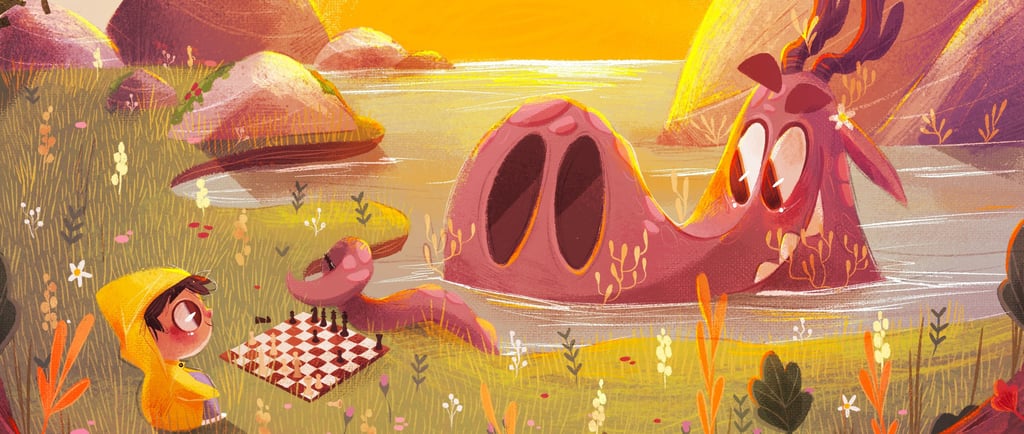
We can’t outline the ultimate checklist for quality, however, there’s one reliable signal to look for: strong picture book illustrations don’t simply repeat the text, they add to it.
With this, I mean the artwork doesn’t need to literally show what the words say. Instead, it often communicates mood, subtext, emotion, or small story details that aren’t written on the page. They complement each other, helping young readers understand more than the text alone.
You don’t need expert training to sense this, if the images feel thoughtful, alive, and emotionally consistent, that’s usually a good sign.
A quick caution about extremely low prices
It’s tempting to see very low per-page prices as a lucky find, especially when you’re eager to move forward.
But extremely low pricing can be a red flag.
It may point to AI-generated or non-original work, which often reveals itself later through inconsistent characters, technical issues, or copyright concerns. These problems usually surface when it’s hardest (and most expensive) to fix them.
This doesn’t mean affordable options don’t exist. It simply means that price should be considered alongside process, originality, and long-term quality.
These are guideposts, not rules
Every picture book journey is different.
Some authors start with a very clear vision. Others discover the book as they go. Some work with teams; others work one-on-one. None of that makes a project more or less “legitimate.”
The goal of this survival kit isn’t to limit you, but to empower you to make early decisions with more confidence and less noise.
If you’re navigating this stage and want guidance or simply a clearer picture of what’s ahead, you don’t have to figure it out alone. Asking thoughtful questions early is often the most professional step you can take.
And that, more than anything, is a strong start.
